
What if your life story could outlive you?
Every person who has ever lived carried a universe inside them, a constellation of memories, lessons, loves, and hard-won wisdom. Most of it disappears the moment they do.
Since the beginning of human civilization, we have been driven by one quiet, persistent longing: to be understood, to be remembered and to be loved. To have someone, someday, know what it felt like to be us. To have laughed at the things we laughed at. To have survived what we survived. To have loved the way we loved. We want to leave an impact in this world when we are gone.
This desire is not vanity. It is something far deeper. It is the reason we tell stories around fires, carve names into stone, write letters we never send, and record voice messages we never delete. Being remembered is how we stay connected to the living world after we leave it.
The illusion of preservation
We live in the most documented era in human history. Billions of photos are taken every day. Videos capture birthdays, sunsets, ordinary Tuesday mornings. Cloud storage holds terabytes of a single person's life. And yet, we are losing more stories than ever before.
Because photos don't capture what you were thinking when you took them. Videos don't record what you were afraid of, what you regretted, what you wished you had said. The folder labeled "Mom" holds a thousand images of her face, but not a single word about what shaped her, what she believed in, or what she wanted her grandchildren to know about the world.
We are not losing memories from a lack of cameras. We are losing them from a lack of questions no one thought to ask in time.
Stories don't live in pixels. They live in the telling, in the pauses, the details, the context that only the person who lived it can provide. When that person is gone, the story goes with them. A hard drive full of images is not a life story. It is a life, muted.
The quiet work of AI listening
This is where something remarkable is now possible. Artificial intelligence, the same technology reshaping industries and rewriting what software can do, is quietly becoming one of the most powerful tools for human storytelling ever created.
AI can ask the questions we forget to ask. It can guide a conversation through decades of a life with patience, curiosity, and depth, returning week after week to the parts of the story still waiting to be told. It can listen without judgment, prompt without pressure, and help someone find language for experiences they have never quite put into words before.
And then it can preserve those stories, not just as recordings locked in a file format that will be obsolete in twenty years, but as structured, searchable, living narratives. Stories that can be experienced as text, as audio, as video, as an interactive archive that a grandchild in 2075 can sit with and explore.
A world where you don't fully disappear
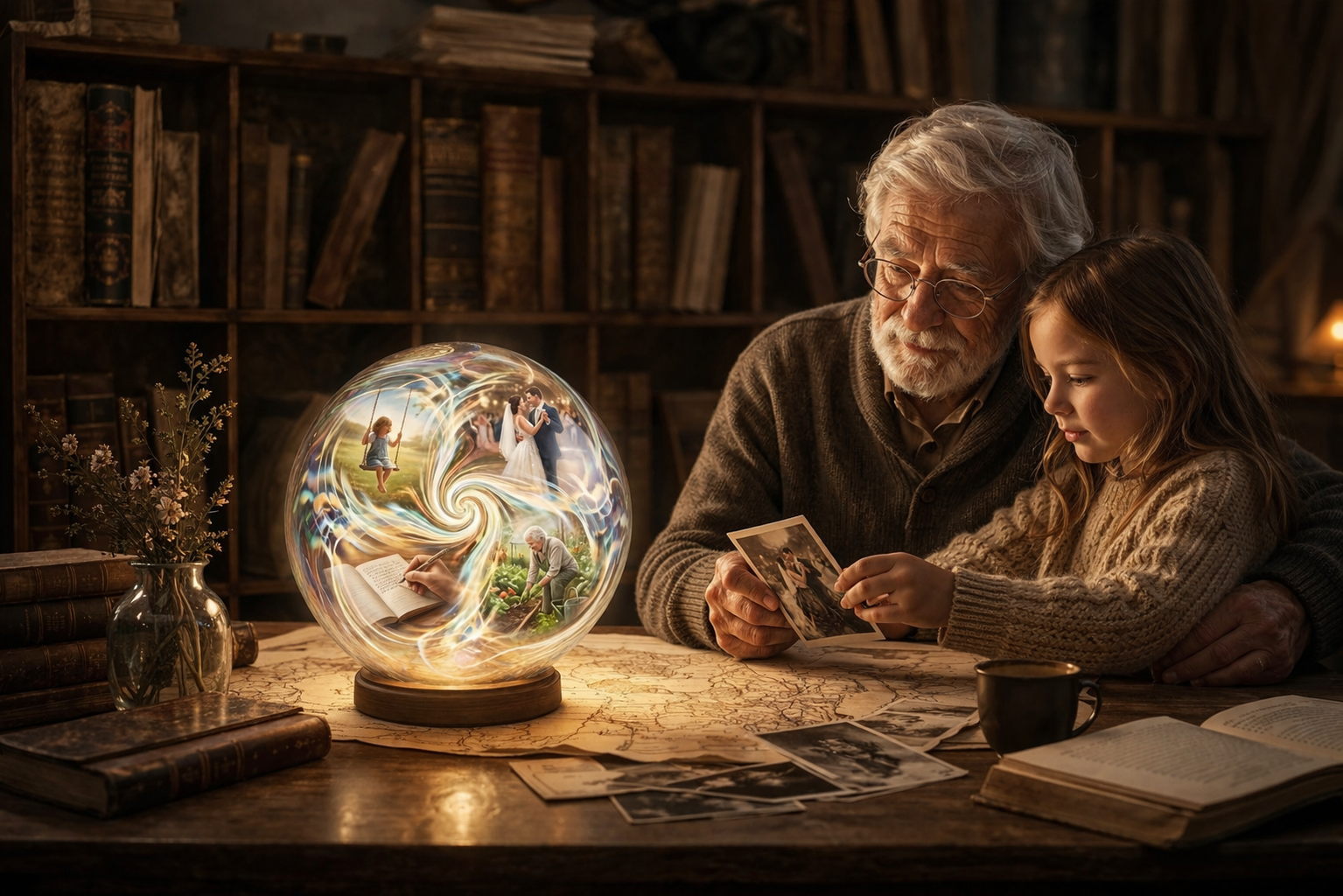
Imagine a future, closer than it sounds, where the stories, values, voice, and wisdom of a person don't end when their body does. Where a digital presence, thoughtfully built from thousands of hours of recorded memory and reflection, continues to exist for the people they loved.
Not as a ghost. Not as a replacement. But as a gift, a version of you that your great-grandchildren can genuinely know. One that can answer the questions they didn't know to ask while you were here. One that carries forward not just what you did, but who you were, what you stood for, and what you want them to carry forward in turn.
The most meaningful thing you will ever leave behind is not what you built, it is the understanding of why you built it, and who you were while you did.
This is not science fiction. The technology exists today. What has been missing is a dedicated space, designed with care, with depth, with reverence for the human lives it holds, where people can do this work before it is too late.
Legacy is not an accident
The stories that survive across generations are the ones that were intentionally told. The letters that got saved. The recordings that someone thought to make. The grandparent who sat down one afternoon and decided to tell the whole truth.
Most of us assume we will get around to it. Most of us don't. Not because we don't care, but because no one ever created the structure, the space, or the gentle guide to help us begin.
LegacyOrb exists to change that. To make the capturing of a human life story as natural, as supported, and as enduring as the life itself deserves.
Your story is worth preserving. Not someday, but now.